William Utermohlen: Self-Portraits of Alzheimer’s Progression
What happens to a person’s sense of self when memory begins to fray?
I often describe dementia as a fragmentation of self. Even as memory and abilities erode, traces of identity can remain — fragments that speak to who the person has been and still is. Our responsibility as caregivers, clinicians, and loved ones is to look for those pieces and honor the person behind the disease.
For the artist William Utermohlen, the earliest signs were practical and subtle: difficulty tying a necktie, trouble managing household finances, increasing memory lapses, and a steady deterioration in handwriting. According to his wife, when he was referred at age 61 he appeared depressed, subdued, and increasingly disconnected from his surroundings. Symptoms had been evolving for several years. There was no family history of neurological or psychiatric illness, and his medical history was otherwise unremarkable apart from a motor-vehicle accident at age 55 that involved a roughly 30-minute loss of consciousness — an event contemporary research recognizes as a potential risk factor for later cognitive decline.
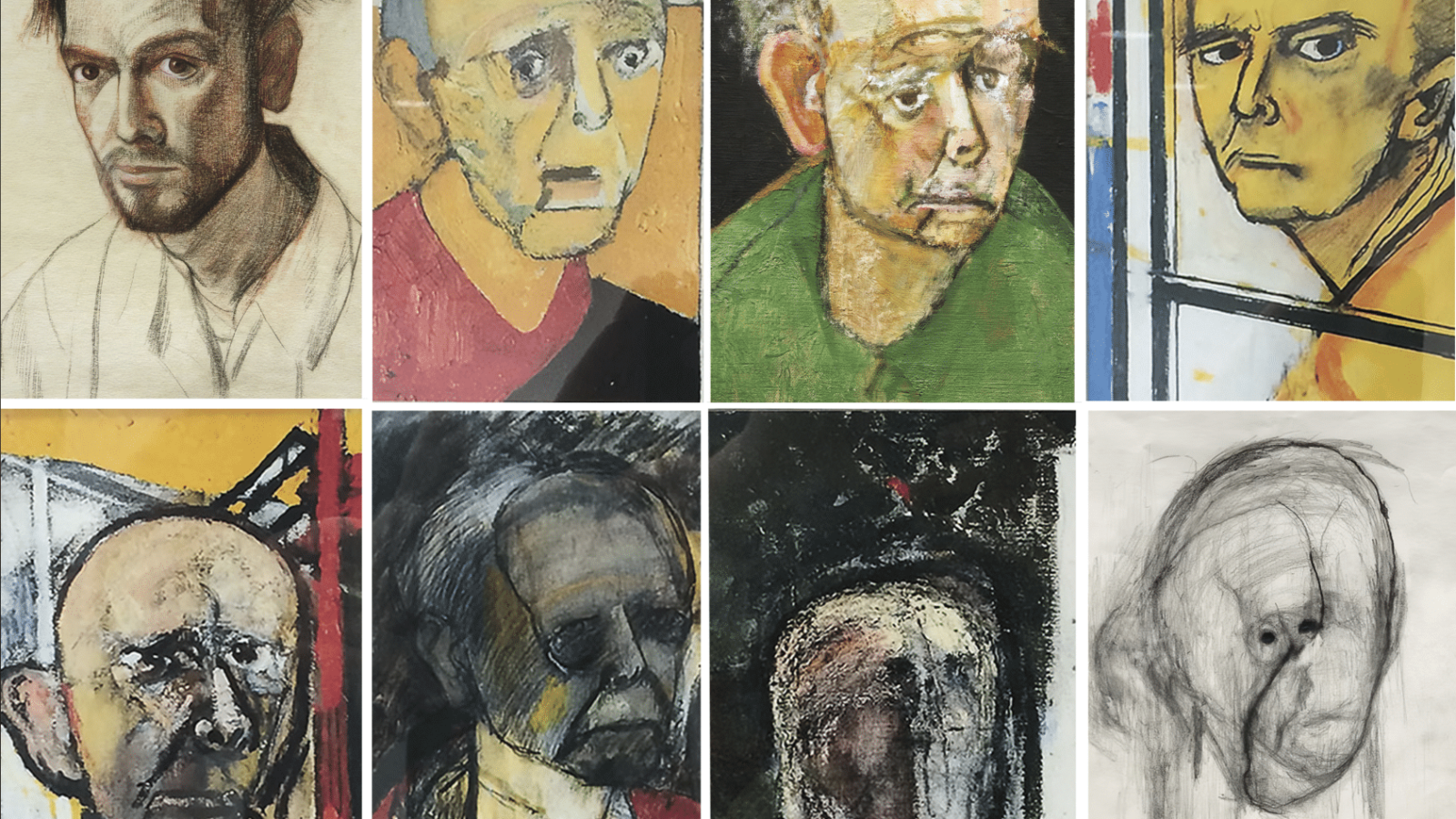
Alzheimer’s Dementia Self-Portraits by William Utermohlen
In 1995 the American-born, London-based painter William Utermohlen received a diagnosis of Alzheimer’s disease. What followed is one of the most intimate visual records of dementia available: a series of self-portraits created over several years that document an artist’s changing perception and identity as the disease progressed.
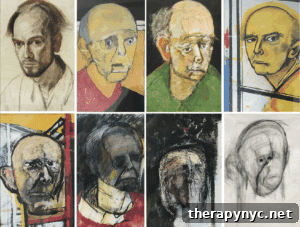
Self-portraits by William Utermohlen; www.williamutermohlen.com
1995: Diagnosis, “Blue Skies,” and a New Way of Seeing
Not long after his diagnosis, Utermohlen painted “Blue Skies” (1995), a large-scale work that captures a subtle shift in perspective. Its simplified planes of color and distorted spatial relationships convey a mood of isolation and altered perception. Shortly after, on the recommendation of a nurse involved in his care, he began a disciplined practice of self-portraiture. That routine maintained an essential part of his identity: “I am a painter.” Practicing his craft became an act of continuity, an assertion of personhood amid decline.
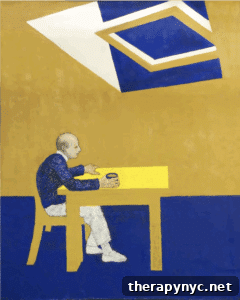
Blue Skies, 1995 by William Utermohlen
Portraits as Record and Revelation
Utermohlen’s serial portraits attracted attention from clinicians and scholars because they provide a visual chronicle of cognitive and perceptual change. Researchers later analyzed the series, and a notable paper in The Lancet (June 2001) discussed artistic changes in individuals with Alzheimer’s disease. The central insight is powerful: acts of creation do more than depict the world — they reveal the creator. In the context of dementia, these revelations become vital evidence of continued subjectivity, emotion, and intent.
Across the years of self-portraiture, Utermohlen’s faces become progressively simplified, abstracted, and stripped of fine detail. That visual trajectory reflects not only neurological decline but also an ongoing engagement with self-representation. Even as features dissolve, the portraits affirm presence: I am here, even as I change.
Care, Continuity, and the Duty to See
Utermohlen continued to produce work until around 2001, when he lost the ability to paint. He died in London on March 21, 2007, after a long illness, cared for by his wife, friends, and professional caregivers. His body of work remains a moving testament to the complexity of identity under the influence of Alzheimer’s.
For those who care for people living with dementia, Utermohlen’s practice offers a model: simple, consistent acts that honor the person’s history and strengths can preserve dignity, sustain identity, and provide meaningful evidence of inner life. Whether through art, music, conversation, or routine activities, we can create opportunities for the person to express themselves and be seen.
Conclusion
Dementia fragments memory and function, but it does not erase personhood. William Utermohlen’s self-portraits remind us that creative expression can document decline while also asserting continuity, individuality, and humanity. The images ask us to look carefully — not only at loss, but at the persistent traces of self that deserve respect, recognition, and compassionate care.
References
- William Utermohlen — artist website and archives (reference to the artist’s documented works and biographical information).
- Crutch SJ (June 2001). “Some Workman Can Blame Their Tools: Artistic change in an individual with Alzheimer’s Disease.” The Lancet, Vol. 357, No. 9274, 30 June 2001, pp. 2129.