Dementia Symptoms That Most Strain Family Caregivers

In more than two decades of providing therapy to families affected by dementia, I regularly hear variations of the same concern:
“Around other people they’re pleasant and conversational, but with me they shut down or get short-tempered. They could treat me differently if they wanted to.”
The reality is more complex. Many emotional and behavioral changes that families attribute to personality or willful behavior are actually behavioral and psychological symptoms of dementia (BPSD). Families and even many clinicians receive little practical guidance about these symptoms, which can cause deep distress for both the person living with dementia and their caregivers.
For countless families I work with, memory loss is only part of the story. The emotional and behavioral shifts—nighttime agitation, harsh or uncharacteristic words from a loved one, hallucinations, or pervasive apathy—often cause more distress than forgetfulness alone. BPSD reliably predict caregiver burden, depression, and earlier decisions to seek residential care, sometimes more strongly than cognitive decline itself.
This article explains what BPSD are, why they occur alongside memory loss, how symptoms change over time, what’s happening in the brain, and how evidence-based, compassionate treatment can reduce suffering for both people with dementia and their families.
In this article, I cover:
- What behavioral and psychological symptoms of dementia (BPSD) are and why they accompany cognitive decline
- Which symptoms typically appear earlier or later in the dementia course
- The brain mechanisms that cause these changes and why they are not simply “personality”
- The impact of BPSD on caregiver well-being and family systems
- How to distinguish “won’t” from “can’t” in caregiving situations
- What effective treatment looks like—nonpharmacologic and pharmacologic approaches
- Why addressing BPSD is an ethical and clinical imperative
What are behavioral and psychological symptoms of dementia (BPSD)?
BPSD are symptoms affecting perception, mood, thought content, or behavior that arise in the context of dementia. Common examples include agitation, depression, apathy, repetitive questioning, psychosis (delusions and hallucinations), aggression, sleep disturbance, wandering, disinhibition, irritability, and socially inappropriate behavior.
Large studies show that most people with dementia will develop at least one BPSD over the course of illness, and many experience several simultaneously. On average, a person with dementia may have multiple mood, motivational, behavioral, or perceptual symptoms in addition to memory and thinking changes.
Common BPSD across the dementia course
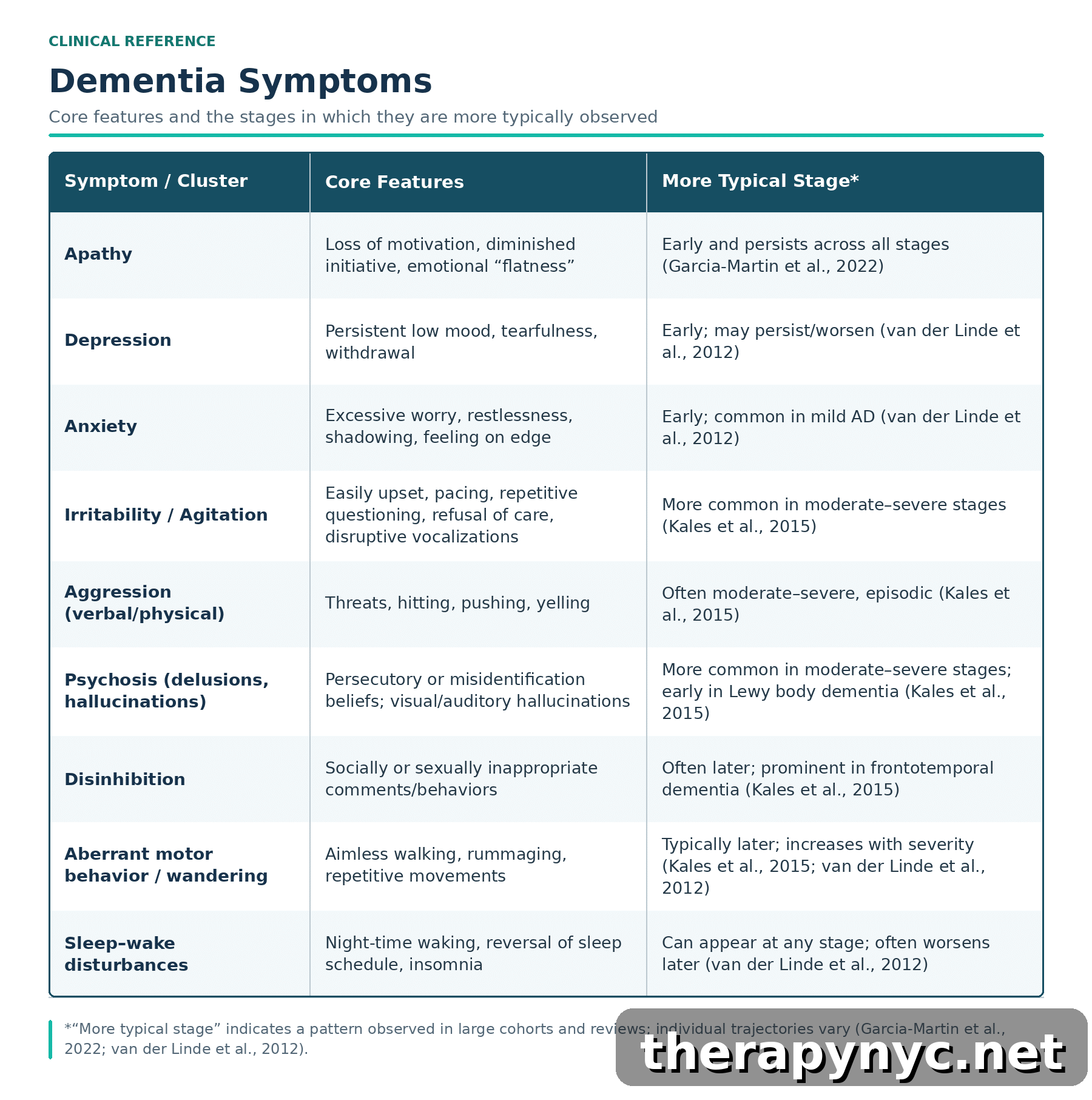
BPSD are not random events. Certain symptom clusters tend to dominate at different stages of dementia, although there is substantial individual variability.
Earlier stages: emotional and motivational changes
In mild dementia and even in mild cognitive impairment, apathy, depression, and anxiety are among the earliest and most common symptoms. Apathy shows as reduced interest and initiative; depression may present as persistent low mood or withdrawal; and anxiety can look like excessive worry, restlessness, or constant seeking of reassurance.
Later stages: agitation, psychosis, and disinhibition
As dementia progresses, irritability, agitation, delusions, hallucinations, and disinhibited or socially inappropriate behaviors become more frequent. Agitation can show as pacing, repetitive questioning, vocalizations, or resistance to care. Delusions and hallucinations are often episodic; hallucinations are especially common in certain dementia types, while disinhibition and wandering are more typical with advanced disease or frontotemporal pathology. Apathy, however, is reported across all stages and often worsens over time.
Why these symptoms are brain-based—not “just personality”
When people say a loved one “could act differently if they wanted to,” it’s usually coming from a place of real hurt. Still, it’s essential to reframe BPSD as neurobiological changes rather than willful behavior. Dementia damages neurons and brain circuits that produce and transmit neurotransmitters—serotonin, dopamine, and norepinephrine—especially in regions that govern mood, motivation, impulse control, and social behavior. The result is both reduced production of emotional messengers and impaired delivery across damaged pathways and receptors.
Imagine fewer mail carriers and broken roads: even when some messages are sent, they often don’t arrive or are distorted. At the same time, brain regions that regulate impulses and emotional responses are affected, making it harder for the person to control reactions that used to be manageable.
“I often describe these neurotransmitters as the brain’s emotional messengers. In dementia, there are fewer messengers being made, and the roads and mailboxes they depend on to deliver their messages are damaged.”
— Regina Koepp, PsyD, ABPP
Behavior is communication
Viewed this way, many behavioral symptoms are a person’s only remaining way to communicate needs—pain, thirst, hunger, fear, boredom, or the urge to use the restroom. As language and cognitive flexibility decline, unmet needs often manifest as agitation, calling out, resistance to care, or wandering. Reframing behavior from “problem to eliminate” to “message to interpret” changes the clinical question from “how do I stop this?” to “what is this behavior telling me?”
Research on unmet needs shows that nearly everyone with dementia in community settings has at least one unmet need—often related to safety, health care, meaningful activity, or planning—and that lack of daytime activity and social contact is consistently linked to higher rates of BPSD.
Common triggers of BPSD include unmet physical needs (pain, hunger, thirst, fatigue), lack of meaningful stimulation or social contact, environmental stressors (noise, unfamiliar settings, overstimulation), unaddressed medical issues, and communication breakdowns when words are no longer available.
Impact on caregivers and family well-being
BPSD are major drivers of caregiver burden, depression, and psychological distress. Disruptive symptoms increase supervision demands, disrupt sleep, reduce the caregiver’s ability to work, and intensify relationship strain. Both objective burden (time, tasks, costs) and subjective burden (grief, emotional exhaustion, role captivity) rise when BPSD are present, and these symptoms are also linked to earlier placement in long-term care and higher health-care use.
Therapists must therefore treat BPSD not as a peripheral issue but as central to supporting the mental health of both the person with dementia and their caregiver.
How caregiver distress can perpetuate BPSD
Dementia affects the entire family system. Caregiver burnout, increased criticism, emotional over-involvement, or withdrawal—known as expressed emotion—can worsen behavioral symptoms in the person with dementia, creating a two-way cycle. This is not about blaming caregivers; it’s about recognizing that supporting caregiver mental health and coping can directly reduce BPSD and improve relationships.
Clinical work with families: distinguishing “won’t” from “can’t”
A core therapeutic task is helping families map remaining abilities and limitations. Someone may still carry out simple procedural tasks with prompts but lack the motivation or executive function for more complex activities like daily bathing. A person can be socially engaged in brief, structured interactions yet become irritable in emotionally charged caregiving moments. Therapy involves validating caregiver grief, assessing strengths and areas of incapacity, and co-constructing realistic expectations and care plans that reduce misattributions of intentional wrongdoing.
Therapeutic elements include:
- Validating caregiver experience and normalizing grief
- Assessing cognitive, functional, and behavioral strengths and limits
- Creating realistic care plans that minimize misattribution of willful behavior
Treatment approaches: nonpharmacologic and pharmacologic
Nonpharmacologic interventions (first-line)
Nonpharmacologic, psychosocial strategies are the recommended first-line treatments for most BPSD. Structured caregiver programs that teach trigger recognition, problem solving, stress management, and activity planning have strong evidence and effect sizes comparable to or exceeding many medications. Interventions include:
- Validation and supportive counseling tailored to cognitive capacity
- Behavioral activation to counter apathy
- Adapted cognitive-behavioral techniques for anxiety and depression
- Reminiscence and life-review approaches that leverage preserved long-term memory
- Cognitive stimulation groups to support social and cognitive functioning
- Caregiver psychoeducation, problem-solving therapy, family systems work, emotion regulation, and self-compassion practices
Pharmacologic options
Medications can be appropriate for specific symptoms—antidepressants for mood and anxiety, and antipsychotics for severe psychosis or dangerous aggression—but they should be used cautiously, individualized, and combined with psychosocial and environmental approaches. Medication is one tool within a broader plan, not a substitute for caregiver support and behavioral strategies.
Refuse to accept suffering as inevitable
People living with dementia and their families deserve comprehensive mental health care. Too often, suffering is treated as an expected and unaddressed part of dementia. That approach is harmful and unacceptable. Better care requires systemic change in how health and mental health services support dementia, and it also requires families and clinicians to insist that behavioral and psychological symptoms be assessed and treated with the same seriousness as memory and function.
When clinicians routinely ask about mood, sleep, behavior, and perception—not just memory—and respond to BPSD with curiosity, compassion, and evidence-based interventions, families and people living with dementia experience less distress and more support.
Further learning
If you want to deepen your skills in therapy for people with dementia and their families, consider training programs and continuing education courses on psychotherapy for dementia disorders, family caregiver interventions, and behavioral management across the stages of dementia.

Related articles
- Therapy for Families and Individuals Following a Difficult Move to Memory Care
- Deception, Relocation, and Dementia Care: Is it OK to Be Untruthful About Moving to Memory Care?
- Transfer Trauma in Older Adults: Relocation Stress, Identity Loss, and How Therapy Can Help
- Grieving Someone Who’s Still Alive: Understanding Ambiguous Loss
- Separation Anxiety in Older Adults: What Every Clinician Needs to Know
- Do Caregivers Really Die Before Their Loved Ones? What the Science Says
- What Is Mild Cognitive Impairment — And How Can Psychotherapy Help?
- Supporting People with Dementia Who Live Alone: Essential Resources
- What Can I Do to Keep My Brain Healthy? — Answers from Brain-Health Experts
- Suicide Risk After Dementia: Why the First Months Are Most Dangerous