ADHD and Relationships: How to Strengthen Your Connection

Attention-deficit/hyperactivity disorder (ADHD) in relationships often looks different from how it feels. One partner with ADHD may struggle with time management while the other finds themselves monitoring schedules and growing frustrated at perceived inattention. Both people can end up feeling misunderstood or emotionally alone—even while sharing the same home.
This guide explains common sources of friction, why those patterns develop, and which practical strategies actually help. It also outlines when professional support may be useful.
Key takeaways
- ADHD affects both members of a relationship: the partner with ADHD may struggle with attention, follow-through, and emotional regulation; the partner without ADHD may feel unheard, overburdened, or emotionally disconnected.
- When ADHD is undiagnosed, relationship strain often grows because there’s no shared framework to explain recurring patterns.
- Familiar dynamics—like a parent-child pattern, a criticism–defense spiral, and uneven household labor—are predictable and can be managed with the right approach.
- Concrete tools—shared systems, ADHD-friendly communication, and dividing tasks by strengths—reduce friction by addressing neurological differences rather than assigning blame.
- Professional help, such as couples therapy and individualized ADHD treatment, can significantly reduce the patterns that most strain relationships.
How does ADHD affect relationships?
ADHD is a neurodevelopmental condition marked by patterns of inattention, hyperactivity, and impulsivity that can persist into adulthood. Adult presentations vary widely, so no two ADHD relationships look the same. Still, partners often report a felt distance—an experience of being inside a home that the other can’t fully see or enter emotionally.
A non-ADHD partner commonly describes this distance as looking into a house from the outside: the interior life is hard to access, no matter how much they try. That sense of disconnection can be experienced by either partner depending on circumstances and awareness.
Below are common ways ADHD-related differences typically present in relationships:
| Category | ADHD partner experiences | Non-ADHD partner experiences |
|---|---|---|
| Attention | Forgetting conversations, plans, commitments, or important dates; often frustrated with themselves | Feeling unheard or having to repeat things repeatedly |
| Communication | Interruptions, losing the thread of long conversations, difficulty tracking multi-step requests | Feeling like conversations don’t land or lead anywhere |
| Emotional dynamics | Intense reactions that may feel disproportionate and hard to regulate | Worry and uncertainty about how to respond to escalations |
| Intimacy | Early intense focus on a partner (hyperfocus) that naturally shifts over time; difficulty staying present during low-stimulation moments | Strong early connection followed by a change that can feel like withdrawal |
| Household responsibilities | Good intentions but difficulty initiating, sequencing, or finishing tasks | Carrying more chores and feeling the imbalance over time |
The effect of undiagnosed ADHD
When ADHD hasn’t been recognized, neither person has a reliable framework to understand recurring patterns. ADHD is more often missed in women and girls, which can unintentionally add strain when one partner lacks information about how the other’s brain operates.
Unaddressed patterns usually intensify as life’s executive-function demands increase—more shared responsibilities, finances, parenting, and household management create pressure. Symptoms like time blindness and poor organization make follow-through harder, compounding friction unless the couple adopts strategies to compensate.
Receiving an ADHD diagnosis at any age can be reorienting: it gives both partners a shared language to talk about ongoing issues and a starting point for constructive change.
Common symptoms in ADHD relationships
Adult ADHD symptoms don’t vanish when someone enters a relationship. Because relationships require steady attention, communication, and follow-through, those symptoms often become more visible. The table below summarizes common symptoms and how they may show up in daily life.
| Symptom | Definition | What it looks like |
|---|---|---|
| Inattention | Difficulty sustaining focus or completing tasks | Forgetting dates, zoning out during conversations, missing plan details |
| Emotional dysregulation | Difficulty keeping responses proportionate | Escalating quickly in disagreements; unpredictable mood swings |
| Rejection sensitive dysphoria (RSD)* | Intense emotional response to perceived rejection or criticism | Taking feedback as an attack, shutting down or responding angrily, seeking reassurance |
| Hyperfocus | Ability to concentrate intensely on stimulating tasks | Intense early focus on a partner or an interest, then appearing to withdraw |
| Poor organization | Struggles with planning and task initiation | Failing to follow through on chores, losing track of shared responsibilities |
| Impulsivity | Acting without considering consequences | Interrupting, spending impulsively, reacting strongly in conflict |
| Time blindness | Difficulty perceiving how long tasks take | Chronic lateness, underestimating time needed |
| Avoidance | Resisting tasks that lack immediate stimulation | Delay of important but boring chores, avoiding phone calls or requests for help |
The strengths ADHD brings to relationships
ADHD comes with strengths that enrich relationships:
- Creativity and spontaneity
- The capacity to hyperfocus on a partner or problem with great intensity
- Deep empathy developed from navigating a world that often doesn’t accommodate their needs
- Enthusiasm for new ideas and experiences that keeps the relationship lively
When both partners acknowledge challenges and strengths, they can design a relationship that supports both people—not just manages symptoms.
The most common ADHD relationship patterns
ADHD creates predictable conditions, so many couples find themselves repeating the same dynamics. Recognizing these patterns is the first step to changing them.
The parent-child dynamic
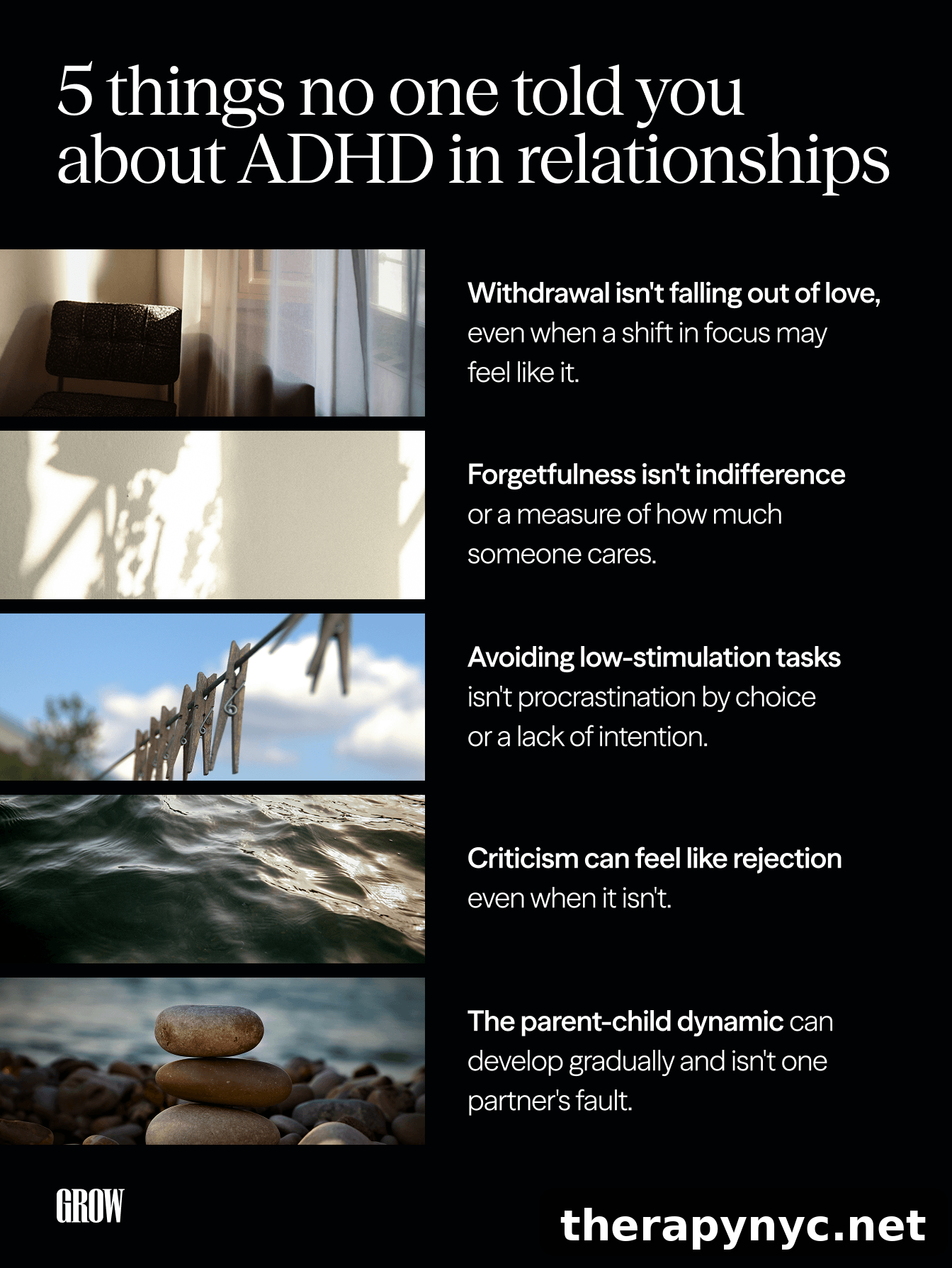
One of the most common and harmful patterns is the parent-child dynamic. It can develop slowly as the non-ADHD partner fills executive-function gaps: organizing tasks, reminding about appointments, and following up. Over time the relationship can stop feeling like an equal partnership—one partner acting as caretaker and the other feeling managed or infantilized. Breaking this dynamic takes awareness, explicit role negotiation, and shared systems.
The criticism-defense cycle
In the criticism–defense cycle, a well-intentioned concern is experienced as criticism by the ADHD partner and therefore triggers defensiveness or shutdown. Because the concern isn’t resolved, it usually resurfaces louder and more urgent next time, causing further withdrawal. This cycle trains both partners to avoid important conversations and increases distance beyond the original issue.
Unequal distribution of household labor
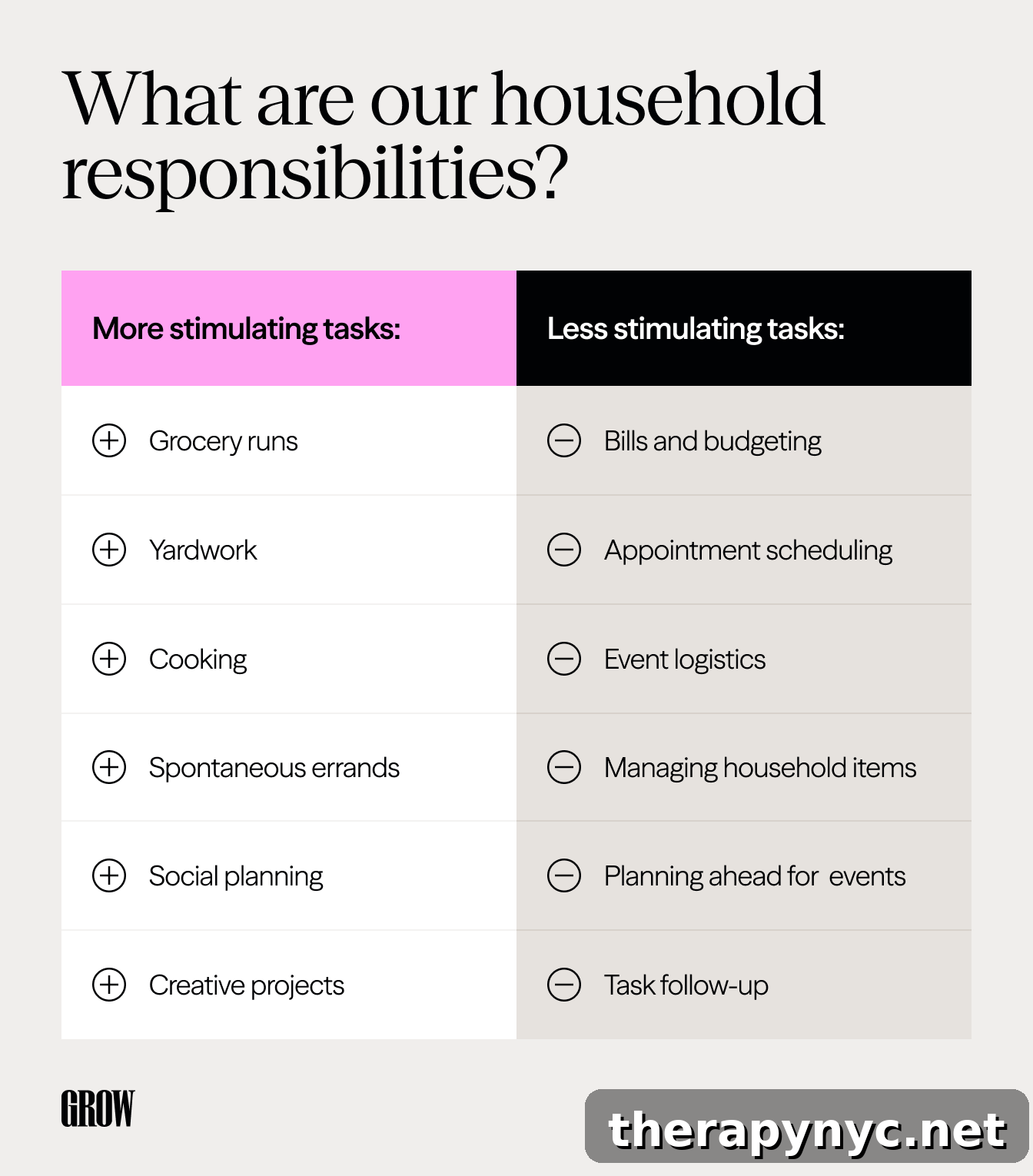
Unequal household labor is a major predictor of relationship dissatisfaction. Executive-function challenges can make initiating and finishing chores difficult, so the non-ADHD partner often ends up carrying more of the routine burden. Understanding the neurological causes won’t erase resentment, but it can shift the conversation from blame to practical, paired solutions.
Strategies that actually help ADHD couples
Whether you pursue clinical ADHD treatment or try at-home solutions, the most effective strategies accept how the ADHD brain works and build external supports around it.
Build relational structure
Adding external structure reduces cognitive load for both partners. Systems mean you aren’t relying on memory or goodwill alone. Examples that help many couples:
- Shared calendars for appointments, events, and recurring tasks.
- Regular check-ins scheduled at the same time to surface issues early.
- Household task boards with clear assignments and deadlines.
- Designated places for commonly misplaced items (keys, chargers, wallets) so they’re easier to find.
These structures are accommodations, not signs of mistrust—practical tools that let partners cooperate rather than conflict.
Separate the behavior from the person
A key reframe is distinguishing symptoms from character. For instance:
- Forgetting isn’t laziness.
- Impulsivity isn’t selfishness.
- Emotional flooding isn’t manipulation.
Seeing actions as symptoms of ADHD opens up more compassionate and solution-focused conversations.
Note
Read reputable psychoeducation resources and relationship guides to learn more about ADHD and how it shows up between partners. Accurate information can be a powerful first step toward change.
Communicate in ADHD-friendly ways
Short-term adjustments in how you talk can make a big difference. Multi-part conversations can overwhelm working memory, so single-topic discussions are easier to track and resolve. Helpful communication habits include:
- Lead with a specific request instead of a general complaint.
- Follow up in writing for important topics so details aren’t lost.
- Prioritize face-to-face conversations when possible; they reduce tone misreads and encourage presence.
- Ask clarifying questions and allow requests to be repeated if needed.
| Non-ADHD-friendly example | ADHD-friendly example |
|---|---|
| “You never tell me where you are.” | “Can you text me when you’re leaving?” |
| “I can’t believe you forgot.” | “I felt disappointed when [situation].” |
| “We’re going to be late again.” | “Just a heads up: we leave in an hour.” |
| “You always start dinner too late.” | “Can you set a timer when you start cooking so we eat before 8?” |
Address RSD directly in conflict
Rejection sensitive dysphoria can cause an ADHD partner to shut down or become defensive, which prevents resolution. When RSD is triggered:
- Non-ADHD partners can lead with curiosity and “I” statements that describe feelings and experiences rather than accusations.
- ADHD partners can practice recognizing the physical and emotional signs of RSD and pause before responding.
A simple shared cue—a raised hand, a pause word, or a brief timeout—can signal that a break is needed to avoid escalation.
Divide responsibilities based on strengths, not strict fairness
Splitting chores 50/50 is appealing but often impractical. Assign tasks according to each partner’s strengths and capacities so the system is sustainable. For example:
- The ADHD partner may prefer more active, stimulating duties.
- The non-ADHD partner may handle time-sensitive or highly organized tasks more often.
The objective is a functional, durable arrangement rather than a perfectly even tally.
How to support a partner with ADHD
If you don’t have ADHD, supporting a partner who does isn’t about ignoring your needs. It’s about responding from understanding while protecting your own well‑being. Practical steps include:
- Learn about ADHD: Understanding it as a neurological condition helps you respond without taking symptoms personally.
- Acknowledge your emotional impact: Your frustration may read as criticism to an ADHD partner; find ways to express your feelings through connection, not blame.
- Value intention as well as action: Distinguishing between intention and follow-through can reduce hurt and build empathy.
- Prioritize self-care: Individual therapy or support can be a place to process your experience and maintain balance.
How to support your own ADHD relationship
If you have ADHD, you might carry shame or guilt. Remember: ADHD is a condition that interacts with relationship demands. You’re not failing as a person. Ways to support yourself and your partner include:
- Develop self-awareness: Learn your patterns and what typically derails you so you can communicate them clearly.
- Design systems together: Co-create structures that suit both partners rather than adopting one-sided solutions.
- Explore evidence-based treatment: Therapies like cognitive behavioral therapy (CBT) and coaching can reduce symptoms that strain relationships.
- Consider medication thoughtfully: If appropriate, medication prescribed by a qualified clinician can be part of a broader approach; discuss options with a healthcare professional.
Find professional support for ADHD in relationships
ADHD-related relationship strain is often treatable when both partners understand what’s happening. Professional support—couples therapy, individual therapy, or ADHD-focused treatment—can provide tools, accountability, and a neutral space to rebuild connection.
If you’re unsure where to start, look for licensed therapists or couples counselors who list ADHD and relationship work among their specialties. A trained clinician can help you apply practical systems and communication methods to your unique situation.