How to Choose a Marriage Counselor: Key Qualities to Look For

Deciding to see a marriage counselor is a powerful step toward strengthening your partnership. Research shows that a large majority of people who attend couples counseling report meaningful improvements in their relationships. Still, knowing exactly how to find the right marriage counselor can be confusing—especially when you factor in licensure, insurance, therapy styles, and practical logistics.
This guide breaks the process down into clear, manageable steps so you and your partner can move from agreement to action. It covers how to set goals together, where to search for qualified providers, what credentials and training to prioritize, how to run useful initial consultations, and what signs indicate it’s time to seek professional help.
Key takeaways
- Begin by aligning with your partner on goals, scheduling, and preferences before you start searching for a counselor.
- Multiple types of licensed professionals offer couples therapy; prioritize their training and experience with relationship work more than the credential alone.
- Use a reliable directory to narrow providers by insurance, availability, and specialization, and always do a short consultation before committing.
- Look for green flags like neutrality, clarity about approach, and inclusive care; watch for red flags such as taking sides or pushing a single outcome.
- You don’t need to wait for a crisis to get help. Many couples seek counseling proactively to build skills and prevent small issues from growing.
1. Agree on your preferences and goals
Before exploring provider listings, talk with your partner about what you both want from counseling. When you start the search with shared expectations, evaluating potential counselors becomes much easier and your final choice is more likely to meet both partners’ needs.
Topics to discuss include:
- What to address: Identify concrete issues (for example, trust, sex, parenting differences) and recurring patterns (communication breakdowns, avoidance, or repeated conflicts).
- Desired outcomes: Define what success looks like to each of you. Outcomes may differ between partners, but naming them helps guide the search and the work in therapy.
- Logistics and preferences: Decide session frequency, preferred days and times, whether you want in-person or online appointments, and whether cultural, religious, or identity-specific competence matters to you.
Some preferences may require compromise, but try to respect each person’s core needs while forming a shared plan for therapy.
Choosing in-person or online counseling
Both in-person and teletherapy can be effective for couples work. Online options increase access and scheduling flexibility, while in-person sessions may feel more personal for some couples. Consider which format best fits your routines and comfort levels.
2. Use a reputable directory to evaluate options
After you’ve agreed on goals and logistics, a well-maintained directory or referral network is the fastest way to find licensed marriage counselors in your area. Good directories allow you to filter providers by insurance compatibility, availability, modality (online vs. in-person), and specialty.
When reviewing listings, prioritize features such as:
- Couples-specific training: Look for therapists who list couples work or specific couple-focused modalities like the Gottman Method or Imago Therapy in their biography, not just as a casual bullet point.
- Insurance and fees: Verify whether a therapist accepts your insurance plan, offers sliding-scale fees, or provides clear self-pay rates.
- Clear descriptions: Strong listings explain a therapist’s approach, the kinds of relationship issues they often treat, and typical session structure.
Starting with a referral?
Personal recommendations from friends, family, or your primary care provider can be a helpful start. Once you have names, check a directory to confirm licensure, insurance compatibility, and availability before reaching out.
3. Prioritize specific training and experience
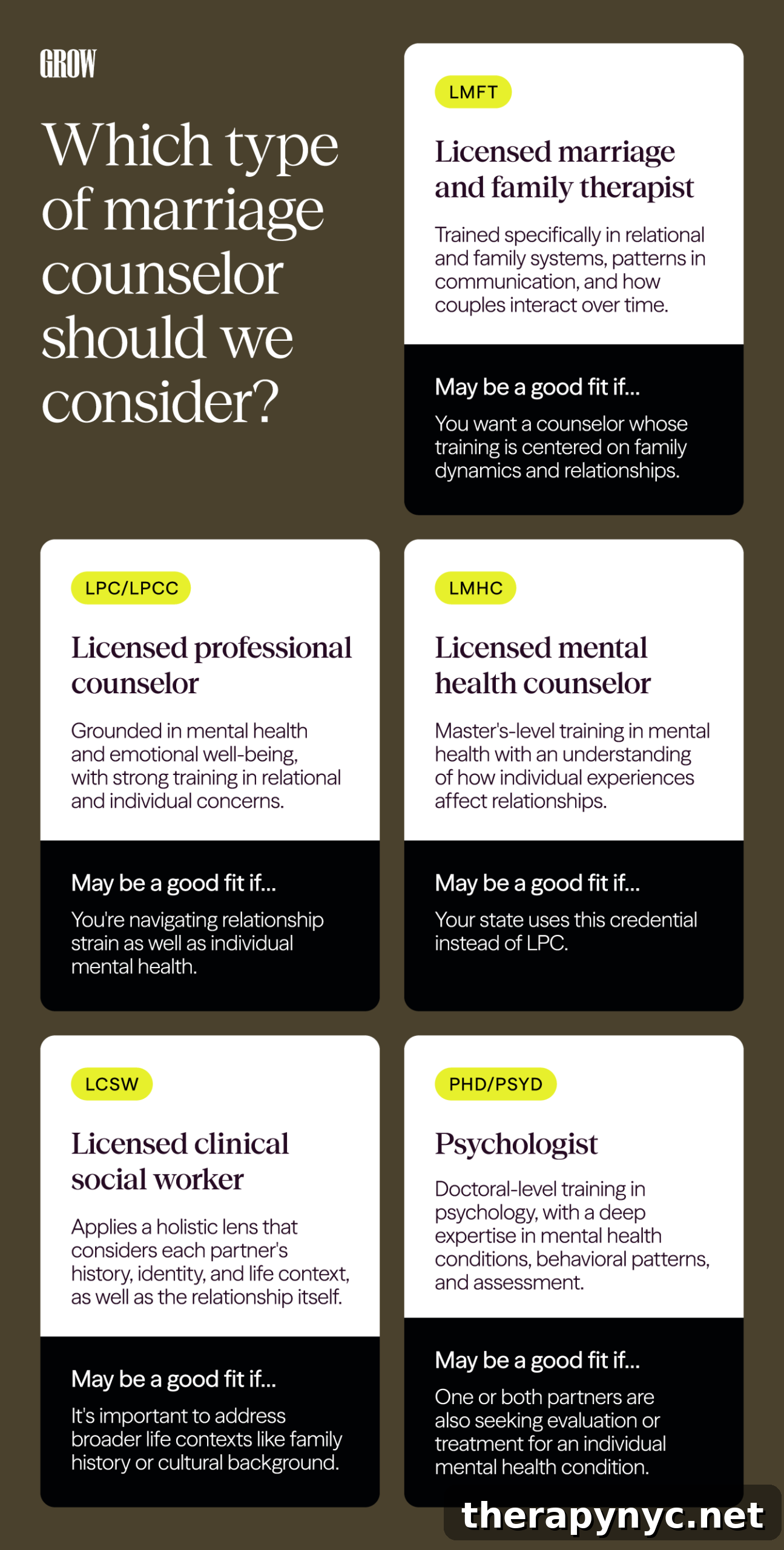
The term “marriage counselor” is broad. Many licensed professionals—LMFTs, LCSWs, LPCs, psychologists, and others—provide effective couples therapy. What matters most is that the clinician has training and experience in relationship-focused approaches and the particular issues you’re facing.
Common credentials and what they typically bring to couples work:
- Licensed Marriage and Family Therapist (LMFT): Specializes in relationship patterns, family systems, and communication dynamics.
- Licensed Professional Counselor (LPC / LPCC): Trained in individual and relational mental health concerns; often skilled in communication and coping strategies.
- Licensed Clinical Social Worker (LCSW): Offers a clinical perspective that considers each partner’s broader social context, identity, and history.
- Psychologists (PhD / PsyD): Doctoral-level training in assessment and mental health, often helpful when individual diagnoses or complex psychological issues interact with relationship problems.
Many clinicians also pursue advanced certifications in couple-specific models. These certifications supplement, rather than replace, a foundational license. Verify licensure with your state board and ask about relevant training during an initial consultation.
4. Conduct brief initial consultations
Most therapists offer a short phone or video consultation at no or low cost. Use this time to assess fit: the therapeutic relationship matters as much as credentials. A solid consultation should leave both partners feeling heard and give a sense of how the therapist would approach your concerns.
Suggested questions for a consultation:
- How do you approach couples therapy, and what models do you use?
- Have you worked with couples facing similar issues to ours?
- What is your availability and recommended session frequency?
- Do you accept our insurance or offer a sliding scale?
- How do you handle situations where one partner wants something different from the other?
If you finish a consultation feeling understood and respected, that’s a strong sign the therapist could be a good match.
Signs it might be time to see a marriage counselor
Couples seek counseling for many reasons—sometimes to address an acute event, other times to repair a slow drift. Common triggers that lead couples to professional help include:
- Recurring, unresolved arguments that circle the same topics without progress.
- Emotional distance where partners feel more like roommates than romantic or committed partners.
- Withdrawal or silent treatment after conflict, creating ongoing disconnection.
- Major life stressors such as illness, loss, job changes, or the challenges of parenting.
- Communication breakdowns about needs, values, or plans for the future.
- Breach of trust or infidelity that both partners want to address together.
- Proactive support: couples who want to strengthen their skills and prevent small problems from growing.
If your relationship involves violence, ongoing abuse, or coercive control, seek individual support and safety planning first. Couple therapy in those situations can increase risk and is often unsafe until individual safety is established.
If you need immediate support
If you or someone you know is in immediate danger or experiencing abuse, contact local emergency services right away and seek specialized domestic violence resources and safety planning. If you’re unsure where to start, local health providers can help connect you to urgent support.
What to look for in a good marriage counselor (beyond licenses)
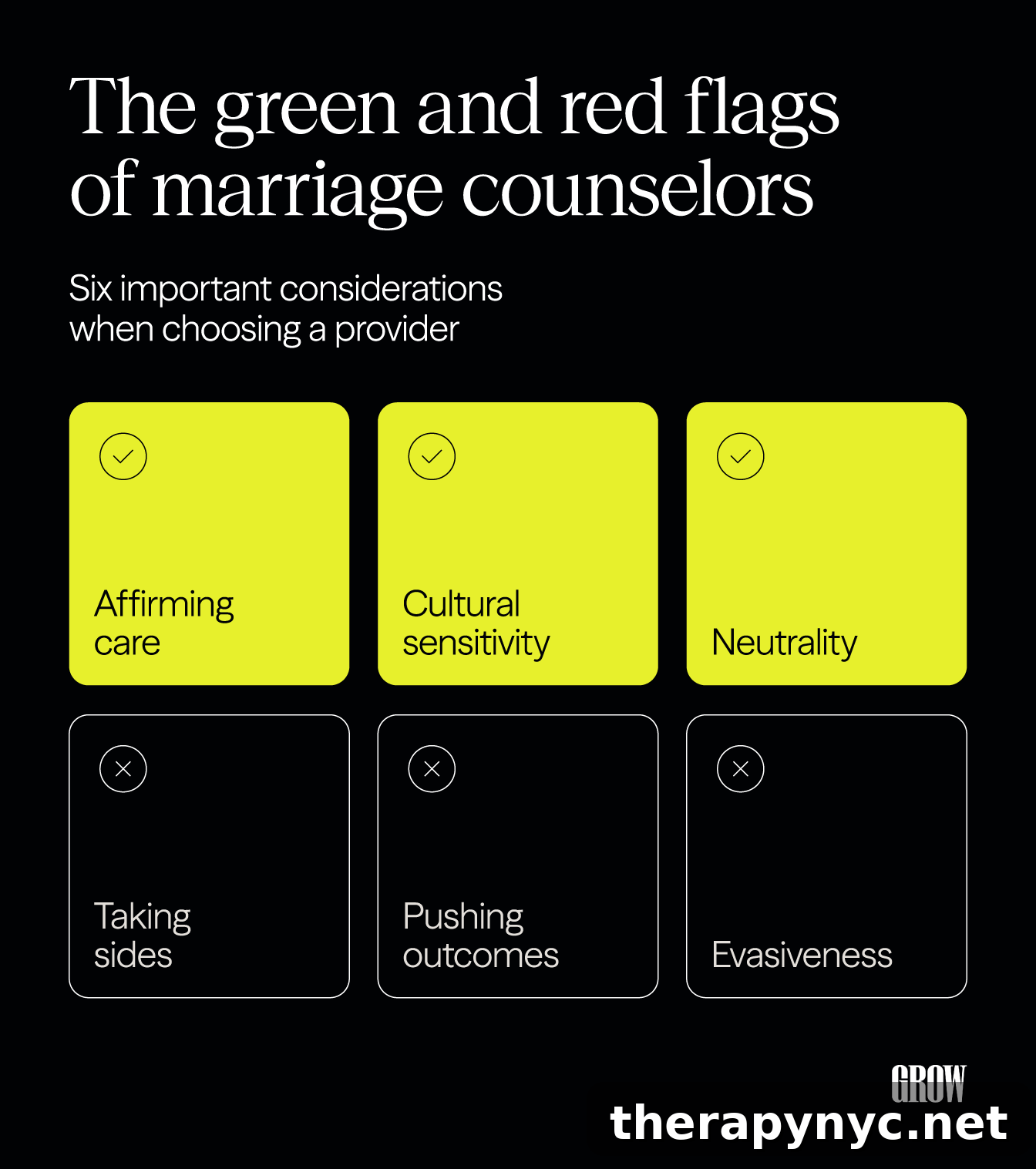
Credentials are important, but so is the way a therapist engages both partners and holds difficult conversations. Consider both green flags and red flags when you evaluate fit.
Green flags to consider
- Experience with relevant issues such as infidelity, grief, or major life transitions.
- Balanced facilitation that encourages honest conversation without escalating conflict.
- Neutral stance where both partners feel equally heard and challenged.
- Clear, structured approach with goals tied to the methods the therapist plans to use.
- Affirming and inclusive care for couples of diverse identities, orientations, and structures.
- Cultural and religious competence if your relationship involves specific cultural or faith-based concerns.
Red flags to consider
- Taking sides or consistently privileging one partner’s perspective over the other.
- Discouraging transparency about training, approach, or billing practices.
- Pushing a preset outcome (for example, insisting you must stay together or separate).
- Unclear answers about licensing, insurance, or fees.
Find the right marriage counselor
To find a therapist who helps your relationship, be intentional: define your shared goals, prioritize therapists with couples-specific training, and vet candidates with brief consultations. The search process itself can be a constructive first step—an opportunity to practice collaboration and clarify what you want from therapy.
Whether you choose in-person or online counseling, focus on finding a licensed provider who understands your needs, accepts your insurance when possible, and offers scheduling that fits your life. Taking these steps increases the chances counseling will lead to real, lasting improvement in your relationship.