Most Parents Seek Professional Support for Student Mental Health

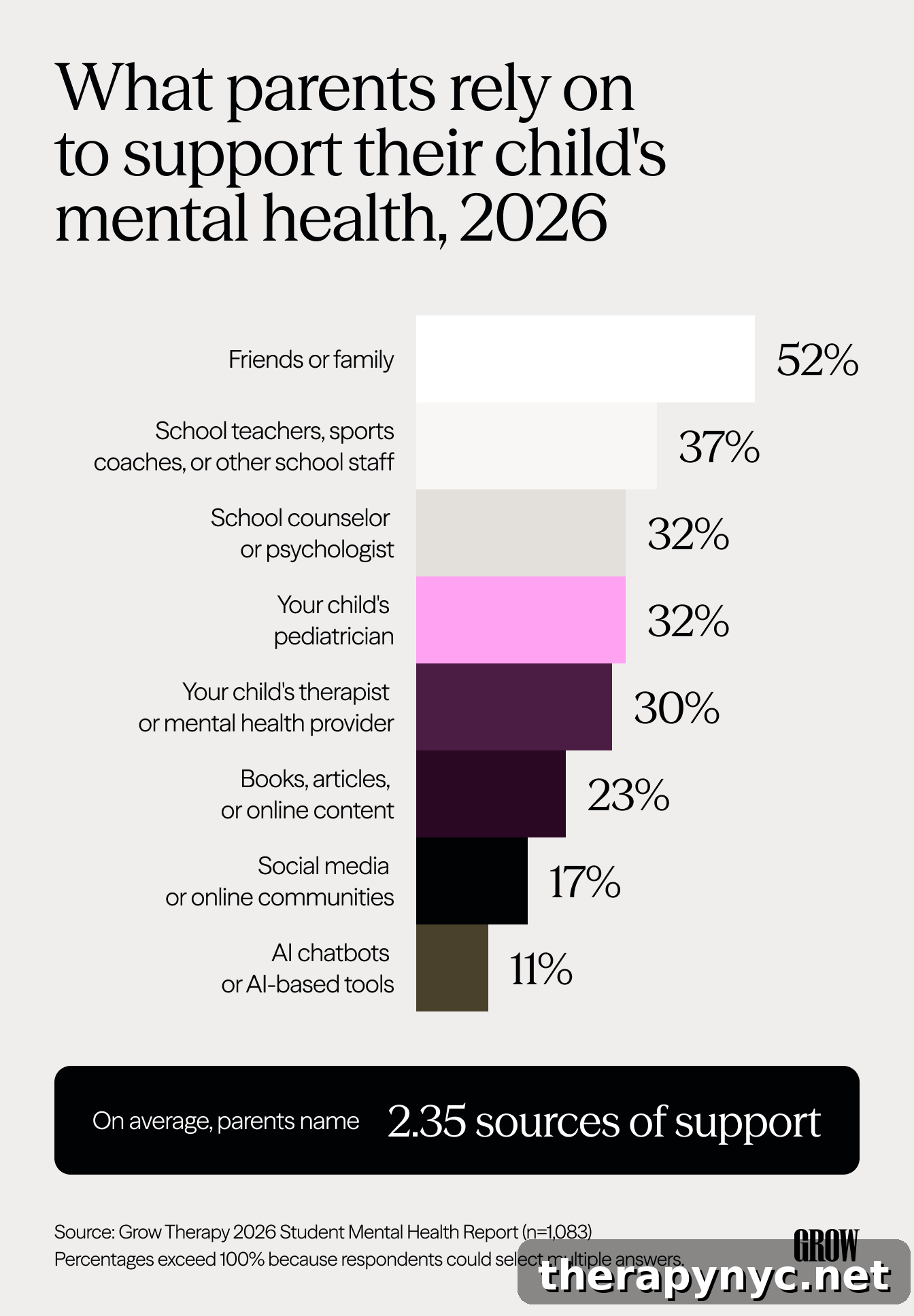
When people say “it takes a village,” they usually mean the network of people who step in when parents need help — a grandparent who picks up a child, a neighbor who watches them for an hour. As a new school year begins, that village is doing much more: parents now report an average of 2.35 different sources of support for their child’s mental health, reflecting how families are drawing on multiple kinds of help as school pressures increase.
Key takeaways
- Support networks have expanded beyond family and friends. Schools (teachers, coaches, and staff) appear in 37% of parents’ networks; school counselors or psychologists in 32%; pediatricians in 32%; and therapists in 30%. Friends and family remain the most common source at 52%.
- The share of parents who sought professional mental health care for their child rose sharply, from about 62% last year to nearly 82% this year — a roughly 20-point increase.
- Younger parents are more likely to use newer digital supports: 19% of parents ages 18–29 use AI chatbots for their child’s mental health, compared with 6% of parents 46 and older. Social media and online communities are also more common among younger parents.
- Relationship and social obstacles grew quickly: a child’s resistance to getting help increased from 11% to 28%, and the share of parents who felt personally judged for seeking support rose from 8% to 20%.
What’s actually in the village raising America’s kids
Family and friends remain the most commonly cited support for parents of school-age children (52%), but many families now rely on multiple adults and professionals. School staff — teachers, coaches, and other on-site adults — appear in 37% of parent-reported networks. School counselors or psychologists and pediatricians each appear in 32% of networks, and a child’s therapist or mental health provider in 30%.
With an average of 2.35 sources of support per parent, reaching beyond immediate family is increasingly typical. Only about 10% of parents rely solely on friends and family; the rest combine family supports with professionals, school-based resources, or other community and digital options. Overall, 63% of parents include at least one clinical or professional source — such as a school counselor, therapist, or pediatrician — in their child’s support network.
Parents are also seeking professional care more quickly than before: the proportion who have sought professional mental health support for their child rose from 62% last year to nearly 82% this year.
The village increasingly includes digital options, too, though use varies by age. Younger parents (ages 18–29) are more likely to turn to AI chatbots (19%) and online communities or social media (25%) than parents 46 and older (6% and 10%, respectively).
Why parents keep widening the circle
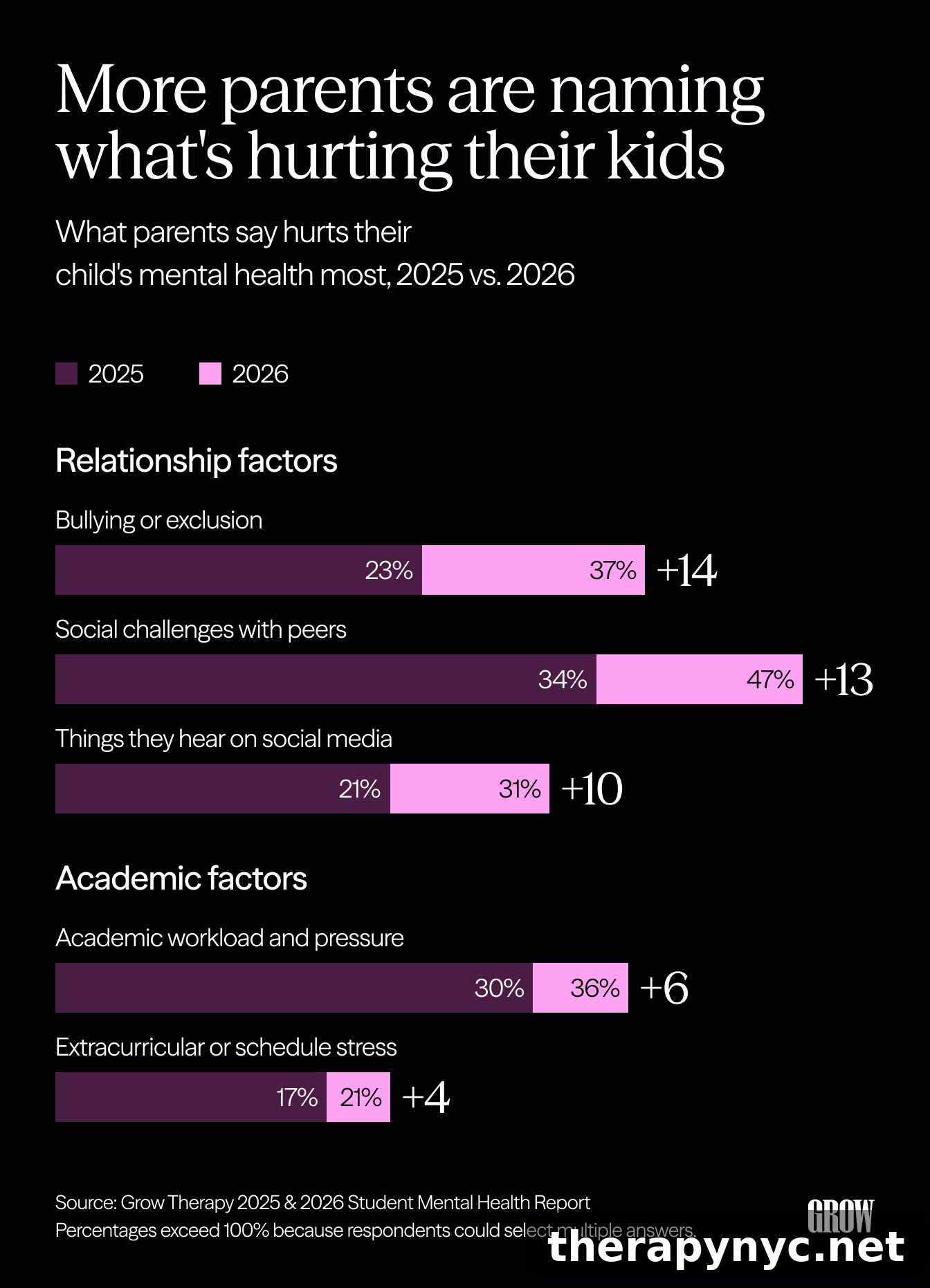
More children are showing signs of struggle than a year ago: 47% of parents say their child has experienced noticeable stress, anxiety, or sadness during the school year, up from 41% last year. Social challenges are the most commonly cited cause: 47% of parents point to peer and friendship difficulties (up from 34%), and bullying or exclusion rose to 37% (from 23%). Academic workload and pressure increased to 36% (from 30%).
Parents are also more likely to identify at least one stressor affecting their child: 80% now name at least one factor, compared with 64% last year. Still, about one in five parents say their child’s mental health has not been negatively affected.
Signs that a child may need therapy
Common indicators include a sustained change in mood or energy, withdrawing from friends or activities, changes in sleep or appetite, falling grades, or unexplained physical complaints like stomachaches or headaches. In tweens and teens, acting out — increased risk-taking, skipping school, or breaking established rules — can also signal distress. A single bad week doesn’t necessarily indicate a longer-term problem; look for consistent changes from a child’s usual baseline. If a child expresses hopelessness, self-harm, or not wanting to be here, take it seriously and seek immediate professional help. In the U.S., 988 is available for free, 24/7 crisis support.
The barriers that grew fastest aren’t about money or waitlists
Although more parents are reaching out for help, barriers to care have increased across the board. The fastest-growing obstacles were relational: a child’s resistance to help increased from 11% to 28%, and the share of parents who reported feeling judged for seeking support rose from 8% to 20%. These are challenges that money alone can’t fix and that programs and providers must plan for when trying to increase access.
Some practical barriers also rose: not knowing where to start climbed from 19% to 29%. Cost or insurance concerns increased from 18% to 26%, and long waitlists from 15% to 22%. While these logistical issues remain important, the relationship-based obstacles expanded roughly twice as fast as the logistical ones on average.
Bringing more people into a child’s care can also bring more opinions — most are helpful, but some can feel intrusive or judgmental. When asked about school-based efforts, many parents said their school does “some, but not enough” to support students’ mental health (45%), and 13% said their school does not support student mental health at all; only 28% felt their school was doing enough. Parents want more mental health education and awareness (44%), better communication between school and parents about wellbeing (41%), stronger anti-bullying programs or enforcement (37%), and access to school counselors or psychologists (36%).
What actually helps, according to parents
Parents say the most effective supports tend to be simple and social. Time with friends tops the list at 52%, and time outdoors or in nature follows at 50%. Team sports (39%), visual arts or creative hobbies (34%), and music or performing arts (34%) also rank highly. In parents’ views, everyday social connection and unstructured activities make the biggest difference.
What this means for parents this school year
Most parents are already broadening their child’s circle of support beyond the immediate family. The next step is to use that village intentionally. Keep other adults in your child’s life informed: teachers, coaches, and pediatricians see your child in different settings and can share observations that fill in gaps you might miss.
If you want to start a conversation with your child’s school, ask about the mental health education students receive and how the school communicates with families when a student is struggling. If school resources are limited, families who don’t know where to begin can look for licensed child and adolescent therapists, using filters like insurance, specialty, and availability to narrow options.
Methodology
This survey was conducted by Centiment for Grow Therapy and fielded from July 17–21, 2026. The results are based on 1,386 completed surveys of U.S. adults aged 18 or older who are parents or legal guardians of at least one child under 18. The full sample answered questions about emotional wellbeing, stressors, preparedness, and barriers to care. A subset of 652 respondents whose child had struggled with stress, anxiety, or sadness answered an additional question about hiding negative emotions. Of the total sample, 1,083 respondents had a child currently attending school and answered questions about school support, future worries, sources of support, perceived pressure to succeed, and helpful activities. Data are unweighted; the margin of error for the overall sample is approximately ±3% at the 95% confidence level. Year-over-year comparisons reference Grow Therapy’s 2025 Student Mental Health Report; differences in vendors, panels, weighting, and field dates mean comparisons should be read as directional.